AI Data Scientist Agent
Intelligent Data Analysis and AI-Powered Analytical Automation
Project Overview
An AI-powered data science project designed to assist with analytical workflows through dataset understanding, preprocessing, exploratory analysis, AI-assisted insight generation, visualization, and reporting.
The Problem
Data analysis workflows often require repeated profiling, cleaning, exploratory analysis, and reporting steps before insights can be communicated effectively.
The Solution & Architecture
The project combines Python data analysis libraries and AI-assisted workflow orchestration to automate supported analytical tasks and present findings through reports and visual interfaces.
Key Engineering Highlights
Project Overview
The AI Data Scientist Agent explores automated analytical assistance. The implementation is presented from verified repository capabilities; provider-specific integrations and every possible agent capability are not assumed.
Problem Statement
Analysts can spend substantial effort on repetitive data understanding, cleaning, exploratory analysis, and report preparation before reaching decision-oriented insights.
System Architecture
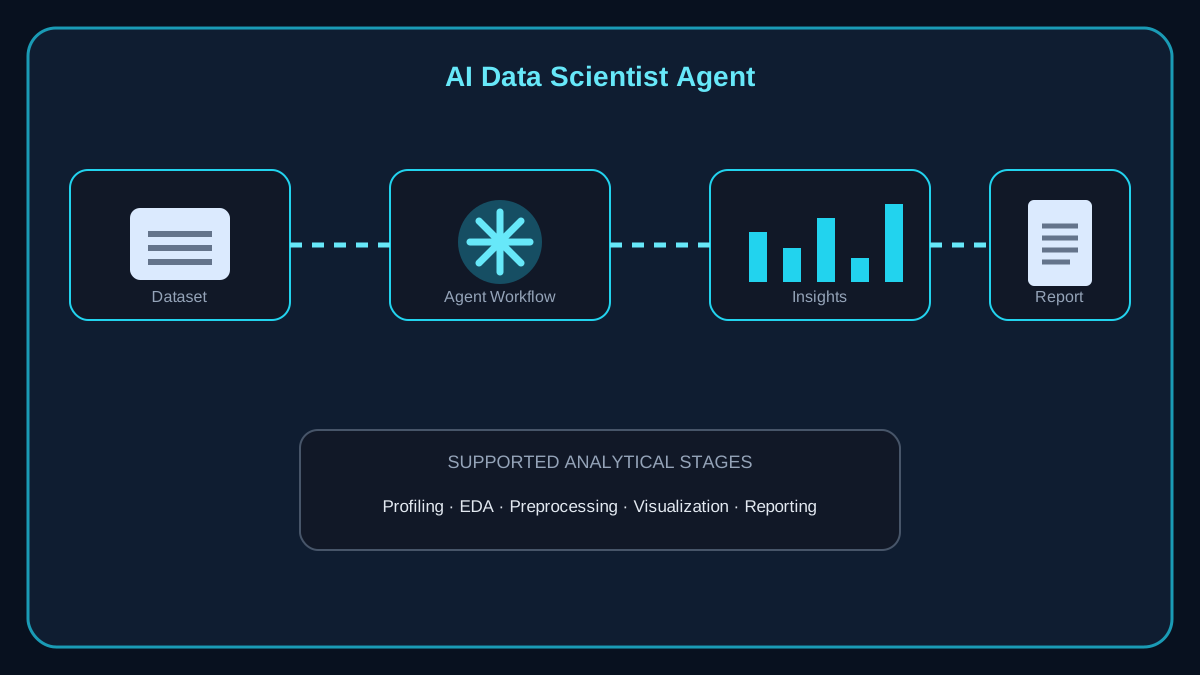
Dataset input is processed by profiling and analytical stages, with AI-assisted orchestration, visualization, and report generation where supported by the implementation.
Agent Workflow
The workflow can sequence dataset loading, profiling, preprocessing, exploratory analysis, analytical interpretation, visualization, and reporting. Each stage is described at portfolio level rather than as a guarantee of a deployed production agent.
Data Processing
Supported data processing may include Pandas and NumPy-based loading, cleaning, transformation, and dataset profiling. Advanced automated operations are treated as implementation capabilities only when present in the repository.
AI Integration
The project uses AI or LLM-assisted workflow components for analytical guidance and report-oriented assistance. Specific provider, model, and deployment details are not asserted beyond the repository evidence.
Analytical Capabilities
Potential capabilities include dataset profiling, descriptive statistics, exploratory analysis, preprocessing, visualization, and model-oriented experimentation. Planned or generalized capabilities are labeled as such rather than presented as verified outcomes.
Visualization and Reporting
The system may present analytical summaries, charts, and generated reports. Specific visualization frameworks and interfaces should follow the verified implementation rather than assumptions.
Technologies Used
The portfolio stack lists Python, Pandas, NumPy, AI/LLM integration, data visualization, and optional FastAPI or Streamlit interfaces. AutoML is included where repository implementation supports it.
Future Improvements
Future work could improve explainability, deterministic execution, validation, data provenance, human review, workflow guardrails, and evaluation of generated insights. Production deployment would require careful testing and data governance.
Technologies Used
Interested in this Pipeline?
I can build similar production-grade Lakehouse or API data ingestion systems for your organization.
Contact Owais Ahmad